
info@mixfoodgroup.com
86 15221870316

The Role of Spray-Dried Diluent Powders in Vitamin & Mineral Premixes
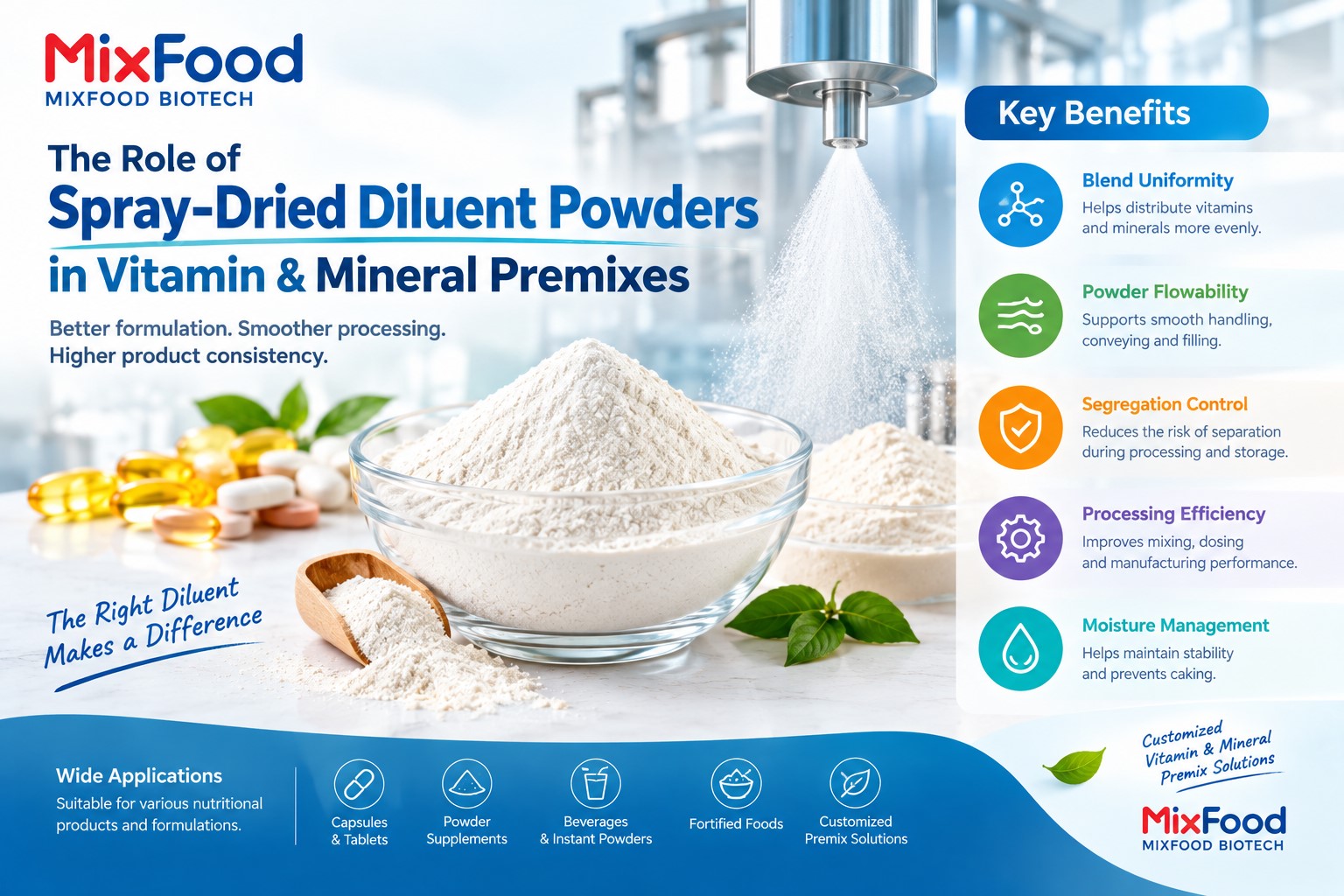
How the Right Diluent Can Improve Premix Uniformity, Flowability and Processing Efficiency
In vitamin and mineral premix manufacturing, selecting the right diluent is about much more than reducing ingredient concentration. It can influence powder flow, ingredient distribution, blending performance, handling efficiency and the overall quality of the finished product.
Spray-dried diluent powders are an important option for manufacturers seeking to optimize the physical properties and processing performance of vitamin and mineral premixes. Depending on their composition and specifications, these powders can help support consistent blending, convenient handling and reliable performance across different nutritional applications.
For premix manufacturers, dietary supplement brands and food fortification companies, understanding the role of spray-dried diluents is an important step toward developing more efficient and application-specific formulations.
In this article, we explore how spray-dried diluent powders work, their potential benefits in vitamin and mineral premixes, the key specifications to evaluate, and how to select the right grade for your formulation.
1. What Is a Spray-Dried Diluent Powder?
A diluent is a functional formulation ingredient used to adjust the concentration, bulk properties or handling characteristics of a powder blend. In vitamin and mineral premixes, diluents help distribute low-dose vitamins, minerals and other active ingredients throughout a larger powder matrix.
Spray drying is a manufacturing process in which a liquid feed is atomized into fine droplets and rapidly dried in a stream of hot gas. The resulting powder may have specific particle shapes, bulk density, moisture characteristics and dispersibility, depending on the feed composition and processing conditions.
Common spray-dried materials used in food and nutritional ingredient applications may include selected grades of maltodextrin, lactose and other suitable carbohydrate-based or functional carrier systems.
However, not all spray-dried powders have the same properties. Their suitability for a vitamin and mineral premix depends on the raw materials, drying conditions, particle-size distribution, moisture content and intended application.
The key principle is simple: the best diluent is not necessarily the finest or most expensive powder, but the one whose specifications match the premix formulation and manufacturing process.
2. Why Are Spray-Dried Diluents Used in Vitamin & Mineral Premixes?
2.1 Supporting Better Ingredient Distribution
Vitamin and mineral premixes often contain ingredients at very different inclusion levels. Some nutrients are present at relatively high concentrations, while others must be incorporated at low dosage levels.
This creates a challenge: ensuring that each portion of the final blend contains the intended nutrient composition.
A suitable diluent can provide additional powder volume and help distribute low-dose ingredients throughout the blend. When its particle size, bulk density and other physical properties are compatible with those of the active ingredients, it may support more consistent blending.
This is particularly important for premixes containing multiple vitamins, trace minerals and other micronutrients.
Formulation tip: Diluent selection should be evaluated together with the mixing sequence, blending time, batch size and the physical characteristics of the active ingredients. A suitable diluent alone cannot guarantee uniformity.
2.2 Improving Powder Flowability and Handling
Powder flowability affects weighing, conveying, feeding, filling and packaging operations.
Depending on the grade, spray-dried diluent powders may offer particle characteristics that support easier handling and more consistent powder feeding. This can be useful when premixes are transferred between processing equipment or dosed into downstream manufacturing systems.
However, flowability is affected by several factors, including particle size, particle shape, moisture, surface properties and storage conditions.
A spray-dried powder should therefore be evaluated using relevant flow and handling tests rather than selected solely on the basis of its manufacturing method.
2.3 Helping Reduce Segregation Risk
Segregation occurs when different particles separate during handling, transport or storage. Differences in particle size, density, shape and flow behavior can cause ingredients to separate, even after a blend has initially achieved acceptable uniformity.
Selecting a diluent with physical properties compatible with the active ingredients may help reduce this risk.
For example, matching particle-size distribution and bulk density where practical can help limit differential movement within a powder blend.
Nevertheless, segregation depends on the complete formulation and process. Particle-size matching alone is not sufficient, and performance should be verified during mixing, discharge, transport and packaging.
2.4 Supporting Consistent Dosing and Manufacturing Efficiency
Vitamin and mineral premixes are commonly used in dietary supplements, fortified foods, beverage powders and other nutritional products.
Their manufacturing processes may involve weighing, blending, conveying, filling, compression or further incorporation into a final food matrix.
A suitable diluent can help the premix achieve physical characteristics that are compatible with these operations. Better-controlled powder handling may also reduce interruptions associated with poor feeding behavior or inconsistent material flow.
The practical benefits depend on the equipment, formulation and target product. Manufacturers should compare the performance of candidate diluents under their actual production conditions.
2.5 Managing Moisture and Physical Stability
Moisture can influence powder flow, caking, agglomeration and the stability of moisture-sensitive nutrients.
Certain spray-dried diluent grades are available with controlled moisture specifications. Depending on the material, they may help formulate a powder blend with suitable handling and storage characteristics.
However, spray drying does not automatically make a powder moisture-proof or guarantee longer shelf life. Hygroscopicity, packaging, ambient humidity, storage temperature and interactions between ingredients must also be considered.
For vitamin and mineral premixes, moisture control should be part of an integrated stability strategy that includes raw material selection, packaging design and appropriate storage conditions.
3. Key Applications in Vitamin & Mineral Premixes
Spray-dried diluents may be considered in several nutritional ingredient applications.
Multivitamin and multimineral premixes
A suitable diluent can help create a consistent powder matrix for blending multiple nutrients with different inclusion levels and physical characteristics.
Dietary supplement powders
Diluents may help adjust powder bulk properties and support weighing, blending and filling operations in powdered nutritional products.
Food fortification premixes
In premixes intended for fortified foods, diluent selection can support compatibility with the target food matrix and the manufacturer's blending process.
Beverage and instant powder formulations
For products that require rapid wetting or dispersion, the diluent's solubility, dispersibility and particle characteristics should be evaluated against the intended preparation method.
Customized nutritional formulations
When a premix must meet specific requirements for flowability, bulk density, particle size or processing behavior, diluent specifications can be adjusted as part of a customized formulation strategy.
It is important to note that a diluent suitable for one application may not be ideal for another. For example, a powder designed for dry blending may not deliver the desired dispersibility in a beverage system.
4. How MixFood Biotech Can Support Your Premix Development
Choosing the right diluent is an important part of developing a reliable vitamin and mineral premix. The optimal solution depends on the nutrient composition, target application, manufacturing process and required product specifications.
At MixFood Biotech, we focus on customized vitamin and mineral premix solutions for nutritional and food applications.
When evaluating a spray-dried diluent or other carrier system, our formulation approach can consider:
• Target nutrient levels and ingredient compatibility
• Particle-size distribution and bulk density
• Powder flowability and blending performance
• Moisture management and storage requirements
• Solubility or dispersibility for the intended application
• Quality documentation and destination-market requirements
Whether you are developing a multivitamin premix, a mineral fortification blend or a customized nutritional powder, aligning diluent specifications with your application can help support more consistent and efficient manufacturing.
Looking for a suitable diluent or carrier system for your vitamin and mineral premix?
Contact MixFood Biotech to discuss your formulation requirements and explore a customized premix solution.
https://www.mixfoodgroup.com/Vitamins--Minerals-Premix-Solutions.html
Conclusion
Spray-dried diluent powders can play an important role in vitamin and mineral premix formulation by helping optimize ingredient distribution, powder handling, flowability and application-specific processing performance.
Their effectiveness, however, depends on the actual material specifications and the complete formulation. Particle size, bulk density, moisture behavior, compatibility, dispersibility and processing conditions should all be considered before selecting a grade.
For premix manufacturers and nutritional product developers, choosing the right diluent specification—not simply choosing a spray-dried powder—is the key to building a formulation that meets its quality and manufacturing requirements.
Name: Mixfood Sales
Mobile:86 15221870316
Tel:86 15221870316
Whatsapp:86 15221870316
Email:info@mixfoodgroup.com
Add:Building 1, 385 Yubei Road, Shanghai, China