
info@mixfoodgroup.com
86 15221870316

How to Mask Unpleasant Odors and Tastes in Vitamin & Mineral Premixes
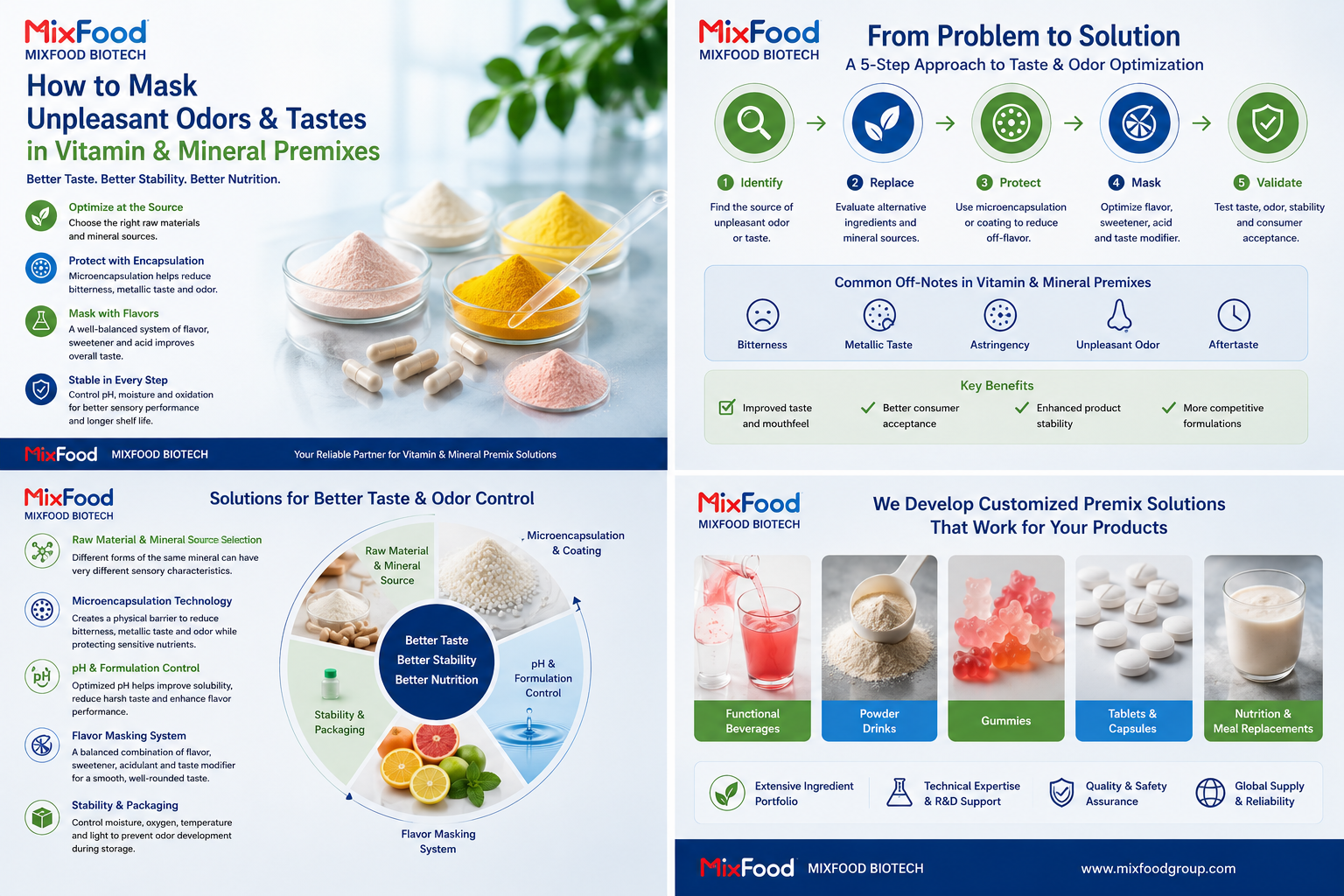 Unpleasant odors, bitterness, metallic taste and aftertaste are common formulation challenges in vitamin and mineral premixes. Learn how raw material selection, mineral source optimization, microencapsulation, pH control and flavor masking can improve the sensory quality of nutritional supplements.
Introduction
Vitamin and mineral premixes are widely used in nutritional supplements, functional beverages, powdered drinks, effervescent products, gummies, tablets and other fortified food applications.
However, formulating a high-quality vitamin and mineral premix is not only about achieving the correct nutrient levels.
Taste and odor can be equally important.
Certain vitamins, minerals, amino acids and other active ingredients may contribute bitterness, metallic sensations, astringency, sourness or unpleasant odors. When these ingredients are combined at relatively high concentrations, their sensory effects can become more noticeable in the final product.
Scientific reviews have shown that vitamins, minerals and amino acids can contribute significantly to unpleasant taste and aftertaste in nutritional supplements, with bitterness, astringency and metallic sensations among the major sensory challenges.
1. Why Do Vitamin & Mineral Premixes Have Unpleasant Odors or Tastes?
There is rarely a single cause.
The sensory profile of a vitamin and mineral premix can be affected by the individual raw materials, their chemical forms, interactions between nutrients, processing conditions and the final product matrix.
Common sensory problems include:
• Bitterness
• Metallic taste
• Astringency
• Sour or acidic notes
• Sulfur-like or unusual odors
• Fishy or fatty odors in products containing certain oils
• Strong vitamin-related odors
• Unpleasant aftertaste
• Odor that becomes stronger during storage
Different nutrients can produce different sensory effects.
For example, certain B vitamins and mineral salts can contribute to bitterness or metallic sensations. Research on nutritional supplements has identified vitamins, minerals and amino acids as important sources of unpleasant taste and aftertaste.
Importantly, the sensory problem may not be caused by one ingredient alone.
When multiple ingredients are combined, sensory interactions can occur. One ingredient may enhance, suppress or modify the perception of another ingredient.
This is why simply increasing the flavor level does not always solve the problem.
2. Identify the Source Before Trying to Mask the Taste
One of the most important steps in developing a better vitamin and mineral premix is to identify the source of the off-note.
Before changing the flavor system, compare the sensory characteristics of:
Individual Raw Material → Premix → Finished Product
This simple approach can help determine whether the problem originates from:
Raw material characteristics
The intrinsic taste or odor of a vitamin, mineral, amino acid or other functional ingredient may be responsible.
Mineral source
Different mineral salts can have significantly different sensory characteristics, even when they provide the same mineral element.
Ingredient interactions
The combination of minerals, vitamins, acids, sweeteners and other ingredients may create a stronger sensory effect than individual components.
Oxidation or degradation
Some unpleasant odors may become more obvious during processing or storage because of oxidation or degradation.
Final product formulation
The same premix may have a very different sensory profile depending on the final dosage, pH, flavor system, sweetener system, beverage matrix and packaging.
Therefore, sensory evaluation should be performed not only on the premix itself, but also on the final application.
3. Review the Mineral Source Before Adding More Flavor
For mineral-containing premixes, mineral source selection can be one of the most effective ways to improve sensory performance.
The same mineral can often be supplied through different chemical forms.
For example, depending on the application, manufacturers may evaluate alternatives such as:
This does not mean that one mineral source is universally better than another.
Mineral
Possible Source Options to Evaluate
Calcium
Calcium carbonate, calcium lactate, calcium glycerophosphate, calcium citrate
Magnesium
Magnesium oxide, magnesium carbonate, magnesium citrate
Potassium
Potassium carbonate, potassium citrate, potassium dihydrogen phosphate
Zinc
Different zinc salts depending on application requirements
Iron
Different iron sources or protected/encapsulated forms
Mineral source selection must consider:
• Elemental mineral content
• Solubility
• Bioavailability
• Regulatory requirements
• pH
• Compatibility
• Precipitation risk
• Stability
• Cost
• Taste and odor
• Final dosage form
For example, changing from one mineral salt to another may improve sensory performance but create a new issue with solubility or precipitation.
Therefore, mineral source optimization should be treated as a formulation balance, rather than simply replacing one ingredient with another.
4. Microencapsulation: A Powerful Tool for Taste and Odor Masking
When an ingredient is nutritionally important but has an undesirable taste or odor, completely removing it may not be an option.
This is where microencapsulation can become particularly useful.
Microencapsulation physically surrounds an active ingredient with a coating or carrier material, creating a barrier between the active ingredient and the surrounding food matrix.
Research reviews have reported that microencapsulation can help mask unpleasant taste and aroma while also protecting sensitive nutrients from environmental conditions.
For vitamins, microencapsulation has also been studied as a way to improve stability during processing and storage. Coating materials can include carbohydrate-, protein-, lipid- and other food-compatible systems, depending on the nutrient and intended release behavior.
Potential benefits of microencapsulation include:
Reduced direct contact between the nutrient and taste receptors
Reduced bitterness
Reduced metallic perception
Reduced undesirable odor
Improved oxidative stability for certain sensitive nutrients
Improved compatibility with other ingredients
Controlled release of active ingredients
Better sensory performance in the final product
However, encapsulation is not automatically the best solution for every premix.
Important parameters include:
Encapsulation efficiency
Particle size
Coating material
Water solubility
Release profile
Processing conditions
Stability
Cost-in-use
Final product texture
Large or poorly designed particles may themselves create undesirable mouthfeel or processing problems.
Therefore, microencapsulation should be designed according to the final application, rather than used simply as a generic masking technology.
5. Flavor Masking: More Flavor Does Not Always Mean Better Masking
Flavor masking is one of the most commonly used approaches for improving the sensory quality of nutritional supplements.
However, simply increasing the amount of flavor can sometimes make the product worse.
Why?
Because taste and aroma are not independent.
Recent sensory research on nutritional supplements found that flavoring can either improve or negatively affect sensory perception depending on the formulation and sensory characteristics of the product. Certain fruity notes can suppress undesirable perceptions such as bitterness or astringency, but the effect is formulation-dependent.
Therefore, flavor selection should consider:
A. The type of off-note
Is the problem mainly:
• Bitter?
• Metallic?
• Astringent?
• Sour?
• Sulfur-like?
• Fishy?
• Fatty?
• Vitamin-like?
B. The dosage of the active ingredients
A product containing a relatively low nutrient concentration may require a completely different masking system from a high-dose mineral or vitamin formula.
C. Product format
Different approaches may be needed for:
• Powder drinks
• Effervescent tablets
• Capsules
• Chewable tablets
• Gummies
• Liquid supplements
• Ready-to-drink beverages
• Protein and nutrition powders
D. Final pH
pH can influence solubility, ionization, ingredient interactions and sensory perception.
Therefore, flavor optimization should be conducted together with pH and formulation optimization.
E. Use Sweetness, Acidity and Flavor Together
Taste masking is usually more effective when several sensory dimensions are balanced rather than relying on flavor alone.
For example, a formulation may combine:
Sweetness + Acidity + Flavor + Taste Modifier
to reduce the perception of bitterness or metallic notes.
Research on nutritional supplement sensory interactions indicates that sweetness, sourness and other taste stimuli can influence the perception of bitterness and other taste attributes.
For a beverage application, for example, a citrus-based system may work differently from a berry-based system.
A tropical flavor may be suitable for one mineral formula but may actually emphasize an undesirable metallic note in another.
Therefore: Flavor masking should be optimized through sensory testing rather than selected purely from a flavor catalogue.
6. Do Not Ignore pH
pH is another important factor when developing vitamin and mineral premixes.
A formulation with an unsuitable pH may experience changes in:
• Mineral solubility
• Precipitation
• Ingredient compatibility
• Color
• Turbidity
• Flavor perception
• Vitamin stability
• Storage stability
For example, an acidulant system such as citric acid may be considered in certain beverage and nutritional formulations.
However, adding acid is not always the correct solution.
If the high pH originates from an alkaline mineral source or carrier system, continuously adding acid may create a new set of formulation problems.
These may include:
• Excessive acidity
• Mineral precipitation
• Poor taste balance
• Reduced stability
• Increased formulation cost
Therefore, pH should be controlled as part of the complete formulation system, rather than treated as an isolated number.
7. Check for Oxidation When Odor Gets Worse During Storage
An important clue is when the product smells acceptable immediately after production but develops a stronger odor during storage.
In this situation, manufacturers should investigate:
• Oxygen exposure
• Moisture
• Water activity
• Temperature
• Light
• Packaging
• Raw material oxidation
• Mineral-catalyzed reactions
• Ingredient interactions
This is especially important for formulations containing oxidation-sensitive nutrients, oils or other sensitive compounds.
Microencapsulation can sometimes help protect sensitive ingredients from environmental factors, but the coating system and release characteristics need to be designed for the specific application.
Conclusion
Unpleasant odors, bitterness, metallic taste and aftertaste can significantly affect the sensory quality and consumer acceptance of vitamin and mineral supplements.
The most effective solution is usually not simply adding more flavor.
Instead, manufacturers should identify the source of the sensory problem and evaluate a combination of:
1. Raw Material Selection
2. Mineral Source Optimization
3. Microencapsulation or Protection
4. pH and Formulation Control
5. Flavor and Taste Masking
6. Stability and Sensory Testing
Scientific literature supports the use of sensory analysis, formulation optimization, flavor masking and microencapsulation as potential strategies for managing undesirable sensory characteristics in nutritional products.
The key principle is simple:
Don't just mask the problem. Identify the source, control the cause, and then optimize the sensory profile.
For manufacturers developing vitamin and mineral premixes, this approach can provide a more reliable path toward better-tasting, more stable and more commercially competitive nutritional products.
MIXFOOD BIOTECH — Customized Vitamin & Mineral Premix Solutions
http://www.mixfoodgroup.com/vitamin-premix-mineral-premix-nutrient-premix-p.html
At MIXFOOD BIOTECH, we focus on customized vitamin and mineral premix solutions for nutritional supplements, functional beverages and fortified food applications.
Our formulation development can consider:
• Vitamin & mineral premix formulation
• Mineral source optimization
• Taste and odor masking
• Microencapsulated nutrients
• pH optimization
• Solubility improvement
• Nutrient compatibility
• Stability optimization
• Customized premix development
If your vitamin and mineral premix has a strong odor, bitter taste, metallic aftertaste or poor sensory performance, the solution may not be simply adding more flavor.
The right solution may start with raw material selection and premix formulation design.
MIXFOOD BIOTECH
Your Reliable Partner for Vitamin & Mineral Premix Solutions
www.mixfoodgroup.com
info@mixfoodgroup.com
Name: Mixfood Sales
Mobile:86 15221870316
Tel:86 15221870316
Whatsapp:86 15221870316
Email:info@mixfoodgroup.com
Add:Building 1, 385 Yubei Road, Shanghai, China