
info@mixfoodgroup.com
86 15221870316

How to Reduce and Control pH in Vitamin & Mineral
Premixes for Nutritional Supplements
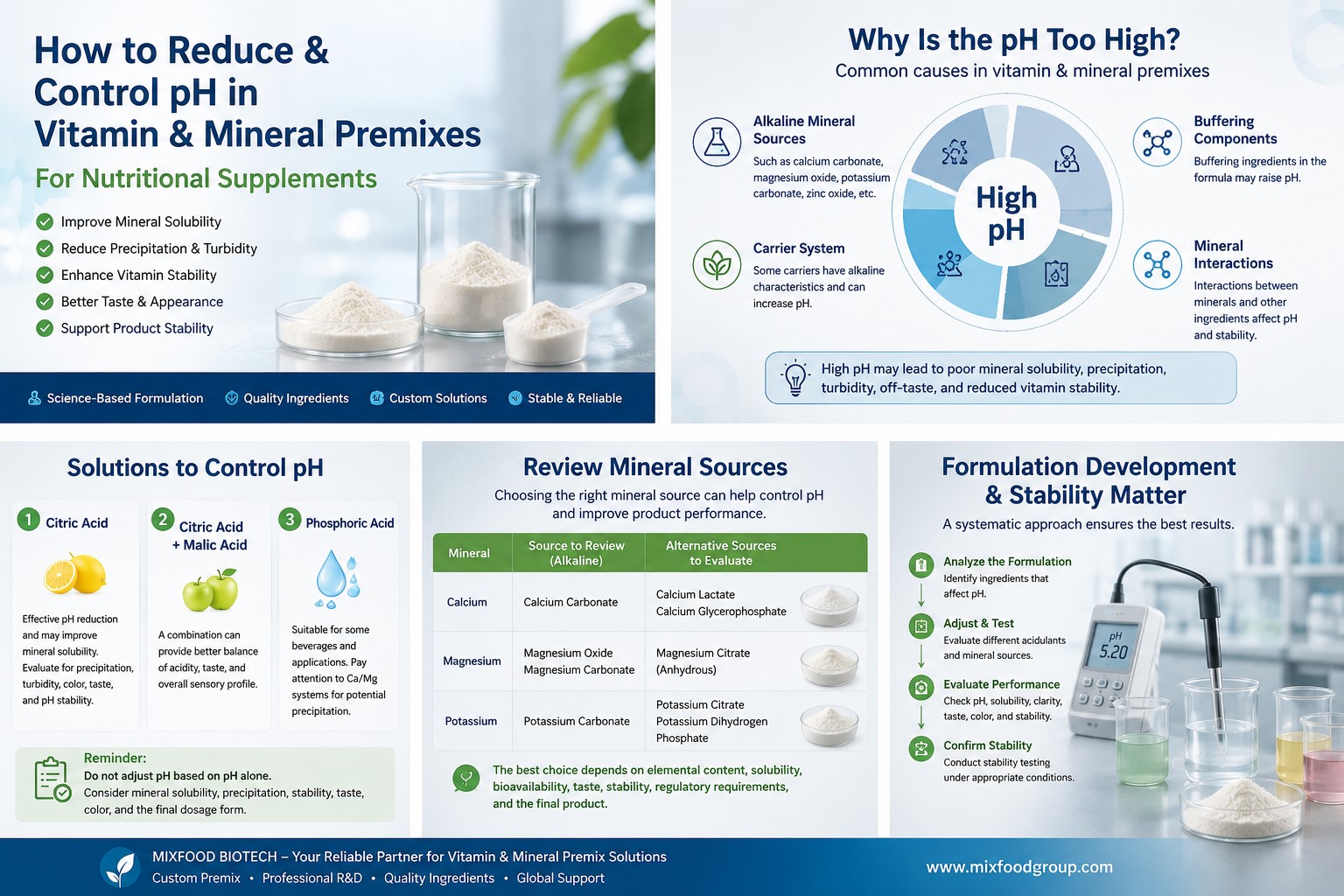
High pH in a vitamin and mineral premix can create formulation and stability challenges in nutritional supplements, functional beverages, and fortified products.
When the final product shows a higher-than-expected pH, simply adding an acid is not always the best solution. The high pH may come from alkaline mineral sources, carriers, buffering systems, or interactions between different ingredients in the premix.
In this article, we explain the main causes of high pH in vitamin and mineral premixes and discuss practical approaches to reduce and control pH while maintaining mineral solubility, product stability, appearance, and sensory quality.
Why Is the pH of a Vitamin & Mineral Premix Too High?
1. Alkaline mineral sources
Calcium Carbonate
Magnesium Oxide
Magnesium Carbonate
Potassium Carbonate
Sodium Bicarbonate
Zinc Oxide
Some mineral salts and carriers have alkaline characteristics and can significantly influence the pH of the premix or final product.
2. Carrier system
The carrier used in a premix can also influence pH. For example, alkaline carriers may increase the pH of the premix and affect the stability of sensitive vitamins.
3. Mineral interactions
Mineral Interactions Can Affect pH and Stability.
Solution 1: Adjust pH with Food-Grade Acids
1. Citric Acid
Advantages:
Mature application in food/nutritional supplement systems
Significant pH lowering effect
Also improves the solubility of some minerals
Flavor relatively easy to control
However, it's important to note: Citric acid not only adjusts pH, but also alters the complexation/dissolution state of minerals such as Ca, Mg, Fe, and Zn.
Therefore, one should not only look at the pH value, but also consider:
Whether precipitation occurs
Whether discoloration occurs
Whether turbidity occurs
Whether a metallic taste develops
Whether the pH shifts after storage
Mineral ions can affect the stability of emulsion systems and colloids, so lowering the pH may actually introduce new stability problems.
2. Citric Acid +Malic Acid
A combination of citric acid and malic acid can sometimes provide a better balance between acidity, taste, and overall sensory profile than citric acid alone. The appropriate ratio depends on the final product, target pH, mineral system, and desired taste profile.
3. Phosphoric Acid
Phosphoric acid can be considered in certain functional beverage and nutritional beverage applications. However, its compatibility with calcium- and magnesium-containing systems should be evaluated carefully because phosphate interactions may influence mineral solubility and precipitation.
Solution 2: Review the Mineral Source
|
Mineral |
Potentially
Alkaline Source |
Alternative
Sources to Evaluate |
|
Calcium |
Calcium Carbonate |
Calcium Lactate, Calcium Glycerophosphate |
|
Magnesium |
Magnesium Oxide / Carbonate |
Magnesium Citrate |
|
Potassium |
Potassium Carbonate |
Potassium Citrate, Potassium Dihydrogen
Phosphate |
The most suitable mineral source depends on the required elemental mineral content, solubility, bioavailability, taste, stability, regulatory requirements, and final dosage form.
Do not adjust pH blindly
A lower pH does not automatically mean a more stable product.
When adjusting the pH of a vitamin and mineral premix, it is important to evaluate:
Need Help Optimizing Your Vitamin & Mineral Premix?
At MIXFOOD BIOTECH, our R&D team develops customized vitamin and mineral premix solutions for nutritional supplements, functional beverages, and other fortified products.
If you are experiencing high pH, precipitation, turbidity, poor mineral solubility, or stability issues in your premix or finished product, our technical team can help evaluate the mineral sources, carrier system, acidulant system, and overall formulation.
Contact MIXFOOD BIOTECH to discuss your vitamin and mineral premix requirements.
About MIXFOOD BIOTECH:
MIXFOOD BIOTECH specializes in food ingredients, nutritional ingredients, vitamin and mineral premixes, and customized formulation solutions for customers worldwide.
http://www.mixfoodgroup.com/Vitamins--Minerals-Premix-Solutions.html
Contact Our R&D Team: www.mixfoodgroup.com
info@mixfoodgroup.com
Name: Mixfood Sales
Mobile:86 15221870316
Tel:86 15221870316
Whatsapp:86 15221870316
Email:info@mixfoodgroup.com
Add:Building 1, 385 Yubei Road, Shanghai, China